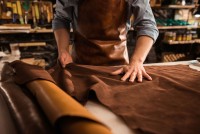
Welcome to TFL’s new Colour Trend Catalogue for the season Autumn-Winter 2027-28. In this brochure we present the colour trends for leather garment, footwear, accessories and upholstery.
Wearing
The tanning industry, after a period of significant transformation and challenge, is entering a phase of new resilience. With a shift toward value, durability and responsibility, the industry reaffirms its dedication to authentic materials and sustainable craftsmanship. Despite past criticism and the rise of alternatives, genuine leather is reclaiming its place as a sustainable material of enduring quality and cultural depth.
Authenticity will be the defining theme for the Fall/Winter 2027/28 season, with a focus on soft volumes and clean, refined colours. Nubuck is emerging as a key material, favoured for its softness and chalky touch. It is proposed in silky versions for leather goods and elegant footwear, as well as in reactive and pullup finishes for more casual and sporty styles. Technological innovation plays a crucial role, with the use of advanced acrylic polymers, waterproofing solutions, synthetic tannins, waxes, and silicones to enhance softness, and colour clarity.
In suede, calf splits and goatskin remain bestsellers, valued for their lightness and vibrant colours. Printed designs inspired by florals, clouds, quilting, and exotic reptiles add decorative appeal, while glossy-matt contrasts elevate more sophisticated products. Full grain calfskin and lambskin are also trending toward greater thickness and compact, well-lubricated grains, achieved through balanced formulations of water-repellent polymers, oils, and renewable vegetable tannins.
Vegetable tanned and chrome-free leathers are experiencing strong growth, supported by innovations in white synthetic tannings, penetrating fatliquors, and high-performance dyes. These developments enhance visual impact, particularly in digital channels, strengthening online sales and reinforcing consumer perception of authenticity. Overall, the industry is combining tradition, technological advancement, and aesthetic innovation to drive its renewed momentum.
In the area of thickness and softness, the wet-blue segment continues to dominate bovine leather production, but advances in industrial chemistry are reshaping the landscape. Bisphenolfree tanning, lightweight acrylic polymers and innovative protein and synthetic fillers enable authentic ‘goose down’ effects. These materials can be dyed with highly concentrated transparent colours and finished with lecithin- and silicone-based water-repellent topcoats, ensuring both softness and performance.
Living
There is a clear sense of renewal in the new collection. What is needed today is softer and thicker leather, colourful nappas, smooth and luminous pull-ups and three-dimensional grains ranging from the most natural looks to refined micro-textures. Today, bisphenol-free tanning is available and can be combined with very light acrylic polymers and innovative protein-based and synthetic fillers.
Nappas, pull-ups, and subtle crazy horse effects give the seating world a more refined and polished feel. Colour plays a major role: cardinal red, tangerine orange, and flamingo pink are prominent shades, reflecting the influence of a Florida that is increasingly at the centre of international political summits.
In the area of full-grain leathers and glossy or frosted finishes, the collection by TFL introduces new topcoats with high adhesion performance. This is made possible by advanced highperformance compounds and modern crosslinkers. Transparent pigments are used to combine depth and coverage, together with a wide range of polyurethane topcoats that are extremely elastic and highly resistant to hydrolysis.
The three-dimensional character of leathers is achieved through three key elements:
Colour: Shades such as camel, powder pink, otter grey, and “latte macchiato” reach their best expression in wet-white tanning. This process highlights the typical straw-white tone of the leather, which becomes central thanks to its classic, creamy, and slightly waxy feel. Natural finishes are preferred for island sofas, while semi-gloss grain effects are more suitable for chairs.
Saturated effect: This concept introduces the use of matt topcoats in different concentrations. The result can range from very compact, blind-tooled looks to delicate marbled nuances, and even to soft, peach-like finishes. The goal is to balance the clean design of the product with the increasingly detailed study of ambient lighting.
Centrifugal effect: This technique is already well established in the tanning industry, but next season it will become an even stronger focus for R&D departments. The aim is to carefully balance retanning and fat-liquoring processes, which can create attractive grain curls and movements in different ways. Particular attention is given to crosslinkers and polyurethane topcoats that protect coatings from humidity and mechanical wear. Finally, silicones remain key players in the finishing world, appreciated for their versatility and their ability to create a wide range of tactile and visual sensations.



 Main Reaction - The TFL Blog Stories, incidents, tips and facts around the topics leather, chemistry, fashion, sustainability and ecology. Our editorial staff consisting of experienced tanners, scientists, market experts, fashion and communication specialists has sharped their pencils and will supply you with fresh and inspiring content on a regular basis.
 LEVOTAN® / LUBRITAN™ - Looking for higher performance? Tanners around the world are facing increasing challenges from their customers, for example, demands for higher performance such as fastness to light and heat resistance, but also lighter weight leather and more recently odour / emissions avoidance.