
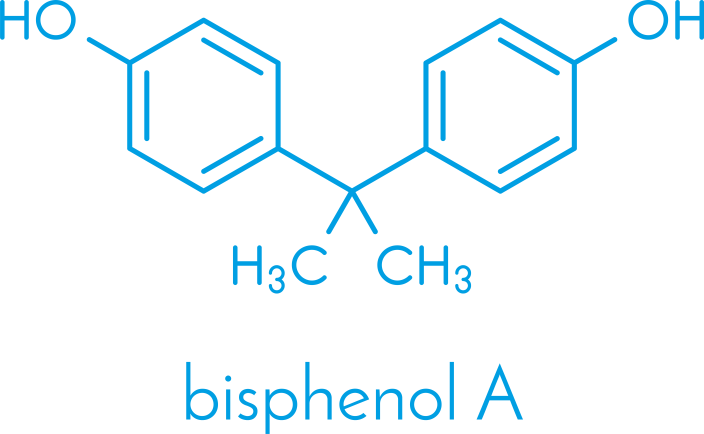
What are Bisphenols?
The Federal Institute for Occupational Safety (BAuA), the German competent authority for REACH, has proposed to restrict Bisphenols with endocrine disrupting properties for the environment. Bisphenols are a group of man-made chemicals that are used in the manufacturing of polymers, such as polycarbonates and epoxy resins. The most widely used chemical in the group, produced in high volumes, is Bisphenol A (BPA).
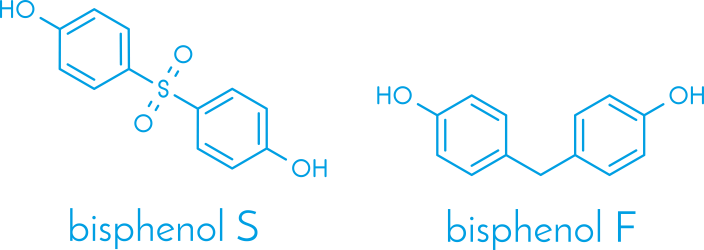
The use of the other Bisphenols, such as Bisphenol S (BPS, CAS 80-09-1) and Bisphenol F (BPF, 620-92-8) is limited in comparison. However, these chemicals are relevant in leather making and are recognized as Bisphenols of Similar Concern (BoSC).

Restriction of Bisphenols in Leather
EU Regulation of Bisphenols of Similar Concern
The regulatory discussion on Bisphenols under EU chemicals legislation remains highly relevant for the leather industry. While BPA is already regulated and of limited relevance for leather manufacturing, current and future measures focus on bisphenols of similar concern, primarily BPS and BPF.
The initial EU restriction proposal published in 2023 was withdrawn. However, the German competent authority BAuA has continued its work and conducted an industry survey with a submission deadline of February 13th, 2026. TFL Ledertechnik GmbH actively contributed to this consultation.
A revised draft restriction is currently expected in Q2 or Q3 2026, followed by a twelve-month public consultation and an eighteen-month implementation phase. Potential transition periods and final limit values for BPS and BPF are still under discussion, including whether there will be a general restriction limit or individual limits for chemicals and articles.
From a classification perspective, BPS is already identified as a Substance of Very High Concern under EU REACH. For BPF, the SVHC consultation is ongoing, with a decision expected by October 2026. A harmonized CLP classification aligned with BPS (Repr. 1B, H360F) is anticipated. SVHCs must be declared when concentrations exceed 0.1 percent in chemical products or articles.
Additionally, BPS and BPF are expected to be classified as endocrine disruptors under CLP for human health and or the environment.
Additional requirements relevant for the leather sector
- ZDHC: BPS and BPF are listed on the ZDHC MRSL V3.1 Candidate List and may be included in MRSL V4.0.
- AFIRM Version 11 (2026): Restriction limit of 500 ppm and reporting limit of 10 ppm in leather for BPS and BPF, respectively.
- GADSL Reference List 2026: Reporting limit of 250 ppm in leather for BPS and BPF, respectively.
- California Proposition 65 (Prop 65): BPS is listed as a reproductive toxicant under Cal. Prop 65. Consumers must be informed that leather articles contain BPS, a substance known to the State of California to cause reproductive harm. BPF is expected to be listed next. For more information go to www.P65Warnings.ca.gov .
Brand RSL’s
Brands are implementing their own Restricted Substances Lists ahead of legislation and often with stricter limit values. This includes very low thresholds for bisphenols that must be met in supplied leather.
Two RSL frameworks are widely applied in the market. AFRIM is mainly used in the fashion and apparel sector, while GADSL applies to the automotive industry. Both list bisphenols as restricted substances.
Chemical products are controlled through the ZDHC Manufacturing Restricted Substances List. TFL is a value contributor to the ZDHC program and certifies its products according to ZDHC MRSL V3.1, ensuring their suitability for compliant manufacturing processes.
Compliance with brand specific RSL requirements remains the responsibility of the leather manufacturer, as RSLs apply to finished leather and articles. As a global leader in leather chemicals, TFL responded immediately to these developments and initiated the development of dedicated solutions to support customers in meeting the new bisphenol limits.
CONCLUSION
The best possible way to ensure compliance to these legislative and brand challenges is to adopt TFL’s newly launched ultra-low to zero bisphenol syntans that replace the major “icon” and well-positioned products and thus enable the vast variety of leather types and properties to be achieved.
Product Name:
- TANIGAN® BNO Liq
- TANIGAN® OVO Liq
- TANIGAN® AGO Liq
- TANIGAN® OSO Liq
- TANIGAN® MBO Liq
- TANIGAN® LFO Liq
- TANIGAN® FAO Liq
- TANIGAN® RLO Liq
- TANIGAN® VRO Liq
- TANIGAN® MBO Gran
- TANIGAN® MBO Powder
- TANIGAN® DSO Liq
All have a bisphenol content of either zero or below the detection limit of 10 ppm (n.d. = non-detectable; ISO 21135:2024). The only exceptions being TANIGAN® MBO Gran, TANIGAN® Powder, and TANIGAN® DSO Liq. With these products you can produce leather below detection level (<10 ppm of bisphenols for the leather) and will be way ahead of any current or expected legislative restrictions!
TFL continues to closely monitor regulatory developments and to engage with authorities and industry stakeholders to support compliance and provide transparent information to its customers.

TFL Ultra-low to ZERO Bisphenol replacement syntans
TFL is a leading global manufacturer and supplier of high quality syntans that are recognized worldwide under the famous brand names of SELLATAN® and TANIGAN®.
To maintain this lead TFL continually invest in pioneering research, development and extensive application support to keep you at the cutting edge of the very latest technological advances.
Building on the leading SELLATAN® and TANIGAN® syntans global success, TFL now launches the next generation of ultra-low or zero BPS/BPF syntans, now unified under the single brand name TANIGAN®. By working together with these new TFL syntans you will be ahead of any current or expected legislative restrictions. These next generation products represent an indispensable new range of genuine replacement syntans that allows the production of leather below detection level (<10 ppm of bisphenols for the leather).
Please keep in mind that the vast majority of TFL’s comprehensive wetend retanning product portfolio is completely free of BPS and BPF under the following well-known trade names: RETINGAN®, MAGNOPAL®, LEVOTAN®, BLANCOROL®, TANNESCO®, DRYWALK®, LEUKOTAN™, LUBRITAN™, SELLASOL® and of course together with all TFL fatliquors and dyestuff ranges etc.
Do you need any further assistance? Get our expert advice.
Testing of Bisphenols in Leather
ISO 11936:2023 - Detection limit for bisphenols: 20 ppm for chemicals / 10ppm for leather.
TFL has already launched an indispensable range of genuine replacement syntans that enable customers to manufacture leathers below the detection limit (n.d.) all developed, manufactured and strictly controlled within TFL’s own production facilities.
- 1
TANIGAN® OSO Liq
Universal replacement syntan for a wide range of applications with well-balanced properties including good fullness and tightness together with dispersing effect
- ultra-low residual monomer content, including free formaldehyde and BPS / BPF (not detectable)
- treated leather has a good degree of whiteness, light fastness and heat yellowing resistance
- 2
TANIGAN® BNO Liq
The ideal replacement syntan for very soft and round leather with a high degree of filling and excellent tanning
- FREE of BPS / BPF
- ideal for milled leather
- 3
TANIGAN® MBO Liq
The ideal replacement syntan for soft and tight leather, equally suitable for white and due to high colour yield also dyed leather with brilliant shades.
- ultra-low residual monomer content, including free formaldehyde and BPS / BPF (not detectable)
- Its tanning power makes it extremely suitable for pretanning, tanning and retanning of wet white and retanning wet blue
- very good light fastness and good heat yellowing resistance
- 4
TANIGAN® LFO Liq
The ideal syntan for very tight, flat “not plumped” smooth grain leather articles
- ultra-low residual monomer content, including free formaldehyde and BPS / BPF (not detectable)
- high degree of whiteness with very good light fastness and heat yellowing resistance
- 5
TANIGAN® FAO Liq
The ideal replacement syntan for firm, compact and tight leather articles
- ultra-low residual monomer content, including free formaldehyde and BPS / BPF (not detectable)
- 49 % bio-content
- highly suitable for retanning waterproof articles e.g., military or “American lifestyle” type
- 6
TANIGAN® VRO Liq
The ideal replacement syntan for milled leather types combining a high degree of tightness and softness , ultra-low residual monomer content, including free formaldehyde and BPS / BPF (not detectable)
- 24 % bio-content
- good fastness to light and heat yellowing resistance thus recommended for automotive articles
- 7
TANIGAN® DSO Liq
Syntan with pronounced dispersing properties applied in combination with other syntans and vegetable tannins
- very low residual monomer content, including free formaldehyde and BPS / BPF (<0.01 %)
- treated leather is firm, with a fine tight grain due to low astringency, with full round handle
_in_the_reach_svhc_candidate_list.jpg_profilex2.jpg)

Do you need our expert advice on Bisphenol & Leather?
-
 Read the full article
Press report | International Leather Maker May/June 2024
Tackling the bisphenol issue
Chris Tysoe, Head of Wet End Product Management for global leatherchemical maker TFL, speaks to ILM about the ongoing issue withbisphenols in leather and the company's approach
-
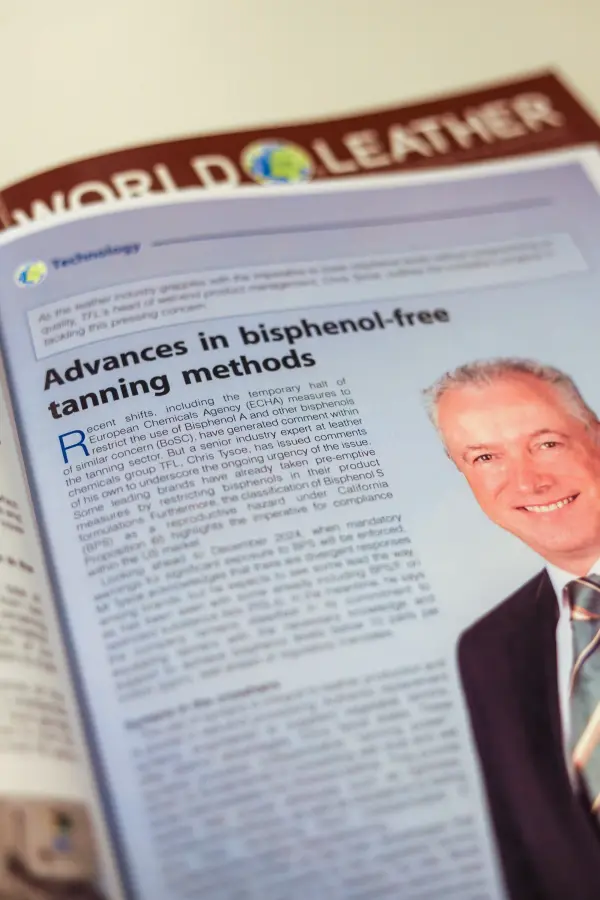 Read the full article
Press report | WORLD LEATHER APRIL/MAY 2024
Advances in bisphenol-free tanning methods
As the leather industry grapples with the imperative to lower bisphenol levels without compromising on quality, TFL’s head of wet-end product management, Chris Tysoe, outlines the company’s progress in tackling this pressing concern.